
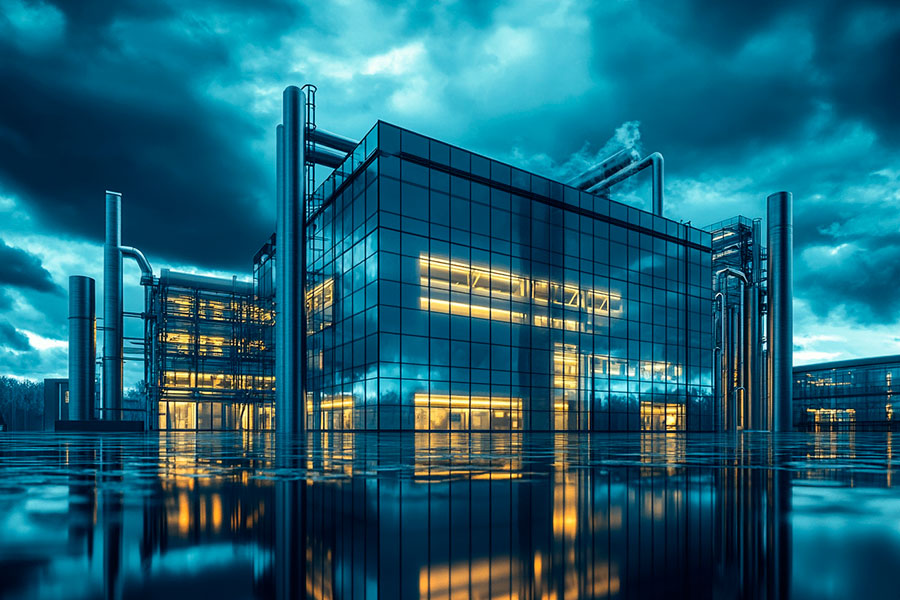
Industrial Process Cooling: Key Applications and Benefits
Industrial process cooling plays a crucial role in ensuring precision, efficiency, and safety in modern manufacturing. Stable temperature control is not just an advantage—it’s a requirement. Cooling needs vary by industry but consistently surpass those of standard commercial buildings.
These systems are engineered to match specific production demands and environmental challenges. Industrial operations often generate extreme heat, which must be controlled to maintain product quality and ensure worker safety.
How temperature regulation works in industry
Industrial process cooling uses advanced thermal control systems to regulate temperatures during production. Keeping machines within optimal temperature ranges improves reliability and reduces energy waste.
Core system components include condensers, compressors, heat exchangers, refrigerants, expansion valves, evaporators, and fluid circulation mechanisms.
- Heat absorption: Refrigerants absorb heat and evaporate, starting the cooling cycle.
- Heat transfer: Exchangers move heat to air or water, removing excess thermal energy.
- Control systems: Smart sensors and automation regulate component performance.
- Fluid flow: Pumps and fans distribute coolant efficiently through the setup.
Industries that rely on process cooling
- Plastic molding and pharmaceutical manufacturing depend on cooling to preserve integrity and efficiency.
- In the food and beverage sector, cooling safeguards freshness and hygiene from production to delivery.
- Steelworks and metallurgy require thermal control for consistent material processing.
- Data centers use robust cooling systems to prevent overheating and maintain uptime.
- Chemical production facilities cool systems to control exothermic reactions safely.
- Hospitals and labs benefit from climate regulation for both equipment and environmental needs. Read more about hospital climate control.
- HVAC systems use cooling for efficient air dehumidification and flow regulation.
Key benefits of cooling technologies
- Enhances product quality
- Boosts manufacturing speed and consistency
- Prevents heat-related equipment damage
- Improves safety in high-temperature environments
- Reduces maintenance and operational costs
Why heat exchangers matter in industrial cooling
Industrial heat exchangers enable rapid, energy-efficient thermal transfer. They outperform traditional air-based cooling systems and are ideal for heavy-duty industrial processes.
- Rapid cooling: Liquid refrigerants extract heat more effectively than air, increasing speed.
- Lower energy use: Efficient design cuts power consumption while maintaining top performance. Explore more on sustainable business practices.
- Equipment longevity: Stable temperatures extend the operational life of machinery.
Tailored cooling systems by Intersam
With nearly 30 years of expertise, Intersam delivers tailor-made industrial process cooling solutions. Our advanced heat exchangers optimize energy use in air-to-water, water-to-air, and air-to-refrigerant configurations.
- Custom engineering and solution design
- Global project execution and support
- Proprietary software for efficient system control
Need a high-performance industrial process cooling solution? Contact Intersam today to get started!


