
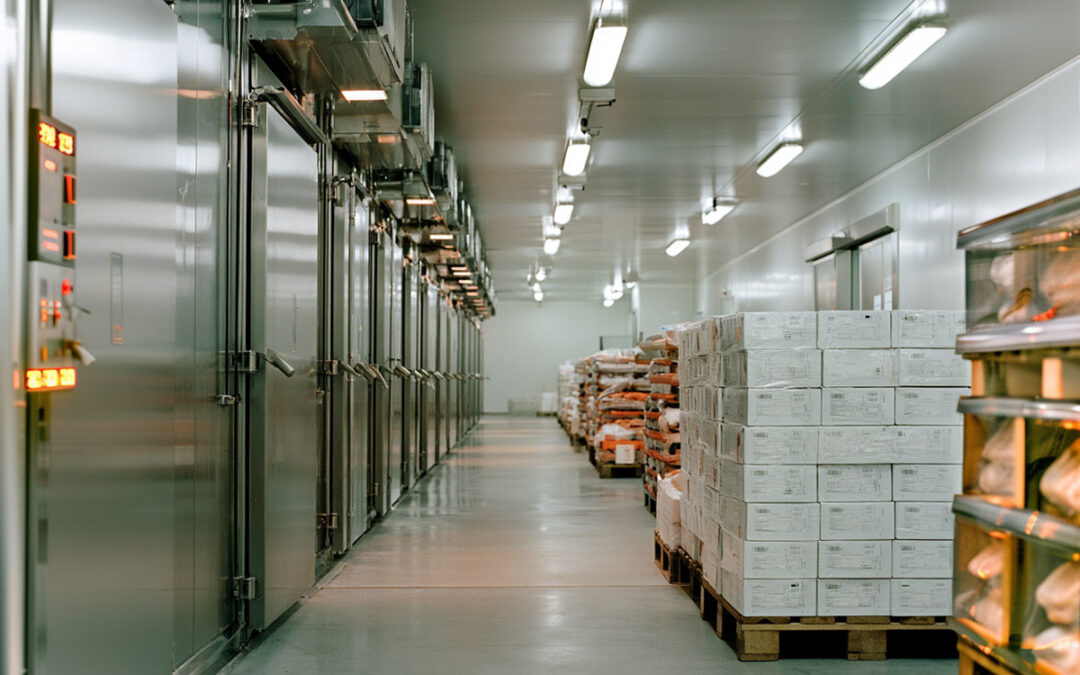
Fish and seafood refrigeration is one of the most important aspects of any facility dedicated to handling and processing seafood products. These raw materials are particularly sensitive to temperature changes, making it essential to maintain suitable temperature conditions from reception through to storage and dispatch in order to preserve their freshness, quality and food safety.
In processing facilities, refrigeration requirements can also vary considerably from one area to another. Reception, sorting, filleting, preparation, freezing, storage and dispatch all require solutions tailored to each process, as well as a refrigeration system capable of ensuring the cold chain remains uninterrupted.
Why is fish and seafood refrigeration so important?
Fish and seafood are highly perishable products. Once caught, a natural deterioration process begins, caused by various microbiological, enzymatic and chemical factors.
Temperature is one of the factors that most strongly influences the speed of these processes. The FAO specifically highlights time and temperature control as one of the fundamental aspects of reducing deterioration in fish and seafood, recommending that chilled products be kept as close to 0 °C as possible.
Proper refrigeration provides several benefits, including:
- Reducing the growth of microorganisms.
- Maintaining organoleptic characteristics for longer.
- Preserving texture, smell, flavour and appearance.
- Reducing product losses.
- Helping to meet food safety requirements.
- Extending commercial shelf life.
- Maintaining the cold chain throughout the production process.
For this reason, the refrigeration system of a processing facility should be considered a fundamental part of its industrial process, rather than simply a system designed to cool cold rooms.
Different refrigeration requirements within a processing plant
One of the main characteristics of fish and seafood refrigeration is that a single facility may need to operate at different temperatures and environmental conditions.
The product’s journey through a plant may begin in a refrigerated reception area and then continue through handling rooms, cold storage rooms, freezing tunnels and finished-product warehouses.
Raw material reception
Maintaining the cold chain begins as soon as the product arrives at the facility.
At this stage, it is essential to minimise temperature fluctuations, particularly when fish and seafood arrive chilled on ice or preserved using other systems.
Proper planning of unloading, holding and sorting areas helps prevent unnecessary exposure to high ambient temperatures.
Preparation and processing rooms
Processes such as gutting, filleting, cutting, cleaning, sorting and packaging require areas where environmental conditions are carefully controlled.
Refrigeration in these rooms must be designed with consideration not only for temperature, but also for factors such as:
- Number of workers.
- Installed machinery.
- Air changes.
- Movement of goods in and out.
- Frequent door openings.
- Ambient humidity.
- Heat load generated during production.
The aim is to maintain stable conditions without adversely affecting either the product or the normal operation of the production lines.
Cold storage rooms for fish and seafood
Cold storage rooms play a fundamental role both in preserving raw materials and in temporarily storing processed products.
For fresh fishery products, European regulations establish that they must be kept at a temperature approaching that of melting ice. For frozen products, Regulation (EC) No 853/2004 establishes, subject to the exceptions provided for in the regulation itself, temperatures not exceeding −18 °C in all parts of the product.
However, reaching a specific temperature is not enough. A refrigeration system must also achieve uniform cold air distribution.
Poor air circulation can create areas with temperature differences, increasing the risk of deterioration in certain batches or resulting in less efficient system operation.
For this reason, the design of evaporators, ducts, air circulation and product distribution within cold storage rooms must be carefully considered.
Rapid freezing for better product preservation
When fish or seafood is intended to be preserved by freezing, the speed of the process has a significant influence on the final quality.
Rapid freezing helps limit the formation of large ice crystals that can damage tissue structure. The FAO states that freezing should be carried out using equipment specifically designed to achieve a high cooling rate, as simply placing fish in a refrigerated storage room does not guarantee sufficiently rapid freezing.
Depending on the product and industrial process, different solutions can be used, such as:
Freezing tunnels, forced-air systems, plate freezers or other specialised technologies designed to reduce product temperature rapidly.
After freezing, maintaining stable temperatures during storage is equally important. Temperature fluctuations can cause partial thawing followed by refreezing, leading to the formation of larger ice crystals and affecting the structure and quality of the fish.
Fish and seafood refrigeration: the importance of humidity control
In a facility dedicated to processing seafood products, temperature is not the only factor that matters.
Relative humidity and air movement can also have a considerable impact on the product.
An excessively dry environment can cause surface moisture loss, dehydration and weight loss. At the same time, poorly managed high humidity can encourage condensation on walls, ceilings, pipes and equipment.
For this reason, temperature, humidity and air circulation must be analysed together when designing refrigeration facilities.
Hygiene and refrigeration system design
Fish and seafood processing facilities operate under strict hygiene and sanitary conditions. The refrigeration system must be integrated into these protocols.
Equipment, evaporators and structural components must facilitate cleaning and maintenance, avoiding areas where dirt can accumulate and minimising the risk of contamination.
It is also particularly important to properly manage:
- Condensation.
- Water drainage.
- Ice formation.
- Defrosting processes.
- Evaporator cleaning.
- Condition of doors and enclosures.
- Airtightness of cold storage rooms.
Good initial design makes these tasks considerably easier throughout the plant’s service life.
Energy efficiency in fish and seafood refrigeration
Refrigeration systems can account for a significant proportion of a processing facility’s energy consumption. Cold storage rooms, refrigerated processing areas, freezers and warehouses may operate for many hours each day, or even continuously.
Improving system efficiency therefore has a direct impact on the company’s operating costs.
Measures that can help improve performance include using correctly sized equipment, automatic control systems, variable frequency drives, heat recovery, improved insulation and operating strategies adapted to actual cooling demand.
Proper preventive and predictive maintenance is also essential, as factors such as dirty heat exchangers, refrigerant leaks, condensers operating under unsuitable conditions or damaged cold storage doors can considerably increase energy consumption.
Temperature monitoring and control in fish and seafood refrigeration
Digitalisation is also playing an increasingly important role in industrial refrigeration systems.
Sensors and monitoring systems make it possible to continuously monitor variables such as:
temperatures, pressures, energy consumption, compressor operation, defrost cycles and potential deviations from established parameters.
This information makes it possible to detect anomalies quickly and take action before they affect the product.
In addition, access to historical data makes it easier to analyse system performance and identify opportunities for energy optimisation.
A refrigeration system tailored to each processing facility
No two fish and seafood processing plants are exactly alike. The type of product, production volume, processes carried out, required temperatures, operating schedules and facility characteristics all have a significant influence on refrigeration system design.
For this reason, a fish and seafood refrigeration project should always begin with a detailed analysis of production requirements.
Correctly calculating refrigeration capacity, selecting suitable equipment and properly designing the different areas makes it possible to achieve a system that is reliable, efficient and capable of maintaining consistent conditions throughout the production process.
At Intersam, we develop industrial refrigeration solutions tailored to the specific characteristics of each industry and process. In facilities dedicated to fish and seafood processing, we assess the refrigeration requirements of each area to design systems capable of ensuring temperature control, energy efficiency, reliability and cold chain continuity.