
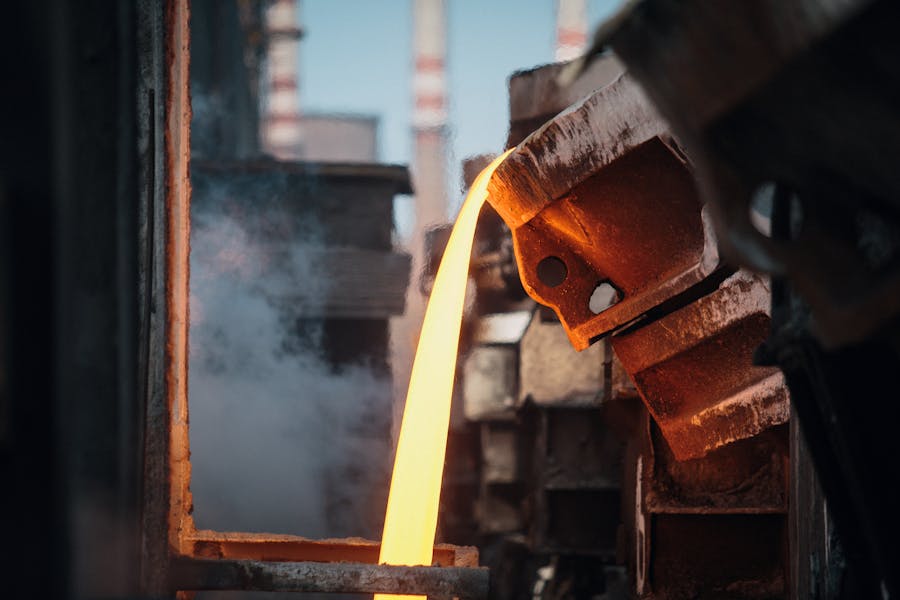
In the metallurgical and steel industry, processes are becoming increasingly sophisticated, demanding advanced technology for heat exchange, essential for handling the high pressures of the fluids involved. Industrial cooling systems employed in these sectors must be equipped with specific devices to ensure energy efficiency and water savings. Proper temperature management is critical, so these systems require extreme optimization and precision in their processes. As we will see, the role of heat exchangers in metallurgy and steelmaking is fundamental.
Basic concepts to understand the importance of heat exchangers in metallurgy
Heat exchangers are essential in the metallurgical industry due to their ability to handle the heating and cooling of materials through specific thermal processes. Indeed, in any industrial operation, utility fluids must reach or reduce their temperature to fulfill their purpose, and this is where heat exchangers become indispensable. These devices facilitate heat transfer between two fluids or gases without mixing, thanks to two sealed and independent circuits – very close to each other – made of materials with high thermal conductivity.
In this same line, thermal conductivity is a key property that determines the efficiency of heat exchangers in metallurgy and other industries. It is measured in watts per meter per degree Kelvin (W/(m x °K)) and reflects the speed at which heat passes through a material. Among materials with higher thermal conductivity, diamond stands out with 2200 W/(m x °K), followed by silver (430), copper (398), gold (315), aluminum (280), and brass (120). Common materials like steel are also used, although their conductivity is lower (50 W/(m x °K)).
Taking this into account, heat exchangers are generally made with metallic materials due to their high thermal conductivity and resistance to extreme temperature and pressure conditions. Copper, aluminum, brass, bronze, iron, and steel are the most common raw materials. These materials are selected not only for their ability to conduct heat but also for their durability, resistance to mechanical stress, and cost. Additionally, water and air, despite having lower thermal conductivity (0.6 and 0.02 W/(m x °K) respectively), are frequently used as heat transfer media due to their availability and ability to transport heat effectively.
Key principles of operation of heat exchangers
Heat exchangers in metallurgy and other processes operate through thermal interaction between two fluids or gases at different temperatures. Without this temperature difference, heat exchangers could not perform their essential function. Within these devices, heat transfer occurs mainly through conduction and convection. Therefore, the design of the exchanger, its effective exchange area, and the materials used in the unit are decisive in the efficiency of this exchange. The equation describing its operation is: Q = C x A x DT, where Q is the amount of heat transferred, C is the heat transfer coefficient, A is the effective exchange area, and DT is the temperature difference between the fluids.
At this point, we invite you to read our post about the key components in industrial refrigeration.
Types of heat exchangers and their operation
According to the direction of the fluids, heat exchangers are classified into parallel, countercurrent, and cross-flow. However, a classification based on their physical structure includes shell and tube exchangers, plate exchangers, and air-cooled exchangers:
- Shell and tube exchanger. This type of exchanger consists of an elongated cylindrical shell containing a set of tubes inside. The internal fluid flows inside the tubes, while the external fluid flows through the shell. This configuration is robust and commonly used in chillers that use water as a secondary refrigerant. In fact, the physical separation between the two fluids allows efficient heat exchange without the risk of mixing.
- Plate exchanger. In this design, a set of corrugated and stacked plates replaces the tubes of the shell and tube model. The plates provide independent and sealed paths for the fluids, allowing for higher thermal performance due to the large exchange surface. Despite this, its main disadvantage is that it does not guarantee reliable sealing under high pressures, limiting its application in certain industrial processes.
- Air-cooled exchanger. As the name suggests, this exchanger uses air as the second cooling fluid and therefore does not require two sealed circuits. It is composed of a coil of tubes with fins, through which a fluid circulates. A fan creates an airflow that passes through the coil, accelerating heat exchange. This design is particularly useful in applications where water is not available or is undesirable as a cooling medium.
Applications of heat exchangers in metallurgy and steelmaking
In the metallurgical industry, heat transfer is a crucial process for cooling and heating materials at different temperatures. Of course, heat exchangers, along with chillers, are essential equipment in these processes, allowing temperature regulation in systems that handle water at extreme temperatures. Plate exchangers, in particular, need to be made with specific materials due to impurities or particles present in the fluids, requiring proper design and seals resistant to high temperatures.
Precisely, aluminum refineries are a good example of the application of heat exchangers in metallurgy. These companies face constant energy challenges and must comply with strict environmental standards while seeking to reduce costs and
improve performance. In this case, packed plate heat exchangers are an efficient solution due to their corrosion resistance and ability to handle aggressive media. Such systems are ideal for aluminum generation, as they allow significant energy savings and high turbulence. Thus, the risk of fouling during operation is reduced.
Heat reuse in nickel extraction
On the other hand, in nickel production, plate heat exchangers are essential for reusing heat generated in other processes. Its design allows for high turbulence and precise control of temperature speed, reducing cleaning frequency and maximizing energy savings. This not only improves process efficiency but also contributes to environmental sustainability.
Heat exchangers in metallurgy for oil cooling in steel production
Undoubtedly, steel production is one of the most energy-intensive activities in the world. Therefore, it is essential to use efficient technology to dissipate residual heat. Plate heat exchangers are especially effective for cooling oils used in equipment lubrication and other processes. Their ability to transfer heat efficiently has proven highly effective in these demanding environments.
Energy saving in zinc extraction
In processes involving zinc extraction, plate heat exchangers are used to reuse extracted heat, thus improving the efficiency of other processes. This, in addition to reducing environmental impact and operating costs, also increases the overall operation performance.
Learn about the innovation applied to heat exchangers in metallurgy from Intersam
At Intersam, we understand that each industrial application demands heat exchangers designed with specific specifications and materials. Since 1995, we have specialized in creating and manufacturing custom-made exchangers to meet the specific needs of your company. Our experts develop advanced solutions for industrial refrigeration and air conditioning projects, ensuring that each system operates optimally. Including infrastructures for climate control in industrial warehouses.
No matter where your project is located, whether in Spain or anywhere else in the world, we are prepared to bring our products and services to you. Contact us and let us know your specific requirements for heat exchangers in metallurgy. At Intersam, we are committed to innovation and quality to offer you the best solution.