
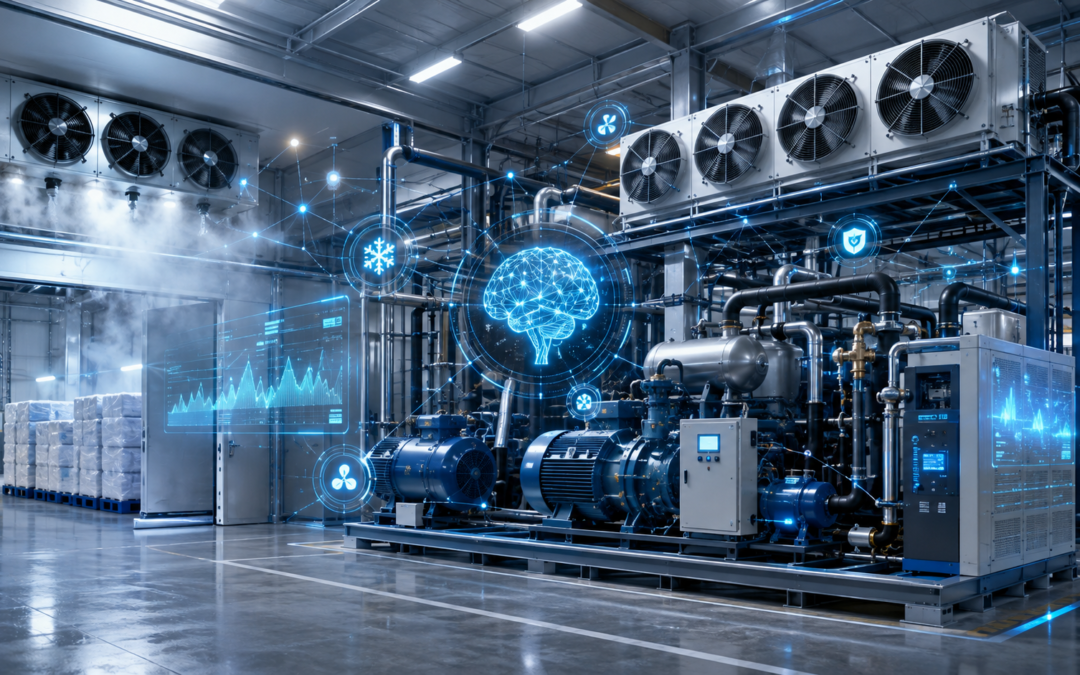
AI Industrial Refrigeration: Efficiency and Predictive Maintenance
AI industrial refrigeration is transforming the way companies manage cooling facilities. Artificial intelligence helps refrigeration systems operate more precisely, reduce energy consumption, automate processes, and identify potential failures before they disrupt operations.
This technology is especially valuable in industries where temperature control, energy efficiency, and service continuity are essential. Food production, cold storage, logistics, manufacturing, and other temperature-sensitive sectors can all benefit from smarter refrigeration management.
However, artificial intelligence does not replace a well-designed refrigeration system or professional technical expertise. Instead, it strengthens both. When companies combine reliable refrigeration equipment with intelligent monitoring and automation, they can improve performance, reduce operating costs, and make better technical decisions.
What Is AI Industrial Refrigeration?
Traditional refrigeration systems often operate according to predefined parameters. In contrast, AI industrial refrigeration can continuously analyze operating conditions and adapt system performance to actual cooling demand.
For example, an intelligent system can consider temperature, environmental conditions, production schedules, thermal load, energy consumption, and equipment status. It can then adjust operating parameters according to the real needs of the facility.
As a result, refrigeration becomes more stable and efficient. The system avoids unnecessary operation while maintaining the required temperature conditions.
In addition, artificial intelligence can work alongside existing monitoring, control, and automation systems. This provides technical teams with a more complete view of the refrigeration facility and allows them to respond more quickly when conditions change.
Intelligent Automation in Industrial Refrigeration
Automation is one of the most important applications of artificial intelligence in refrigeration facilities. Intelligent control systems can regulate compressors, fans, valves, pumps, and defrost cycles according to actual operating requirements.
This approach prevents equipment from running harder or longer than necessary. Consequently, companies can lower energy consumption while reducing mechanical wear.
For example, a cold room may experience a lower thermal load during certain hours. Instead of maintaining the same operating level throughout the day, the control system can adapt refrigeration capacity while keeping the correct temperature.
Likewise, if the system detects unusual operating conditions, it can generate an alert or modify certain parameters. Early intervention can prevent a small deviation from becoming a serious technical problem.
How AI Industrial Refrigeration Reduces Energy Consumption
Energy represents a significant operating cost in many industrial refrigeration facilities. Therefore, improving efficiency can have a direct impact on both operating expenses and environmental performance.
AI industrial refrigeration supports energy optimization by continuously analyzing how, when, and where the facility consumes electricity. This makes it easier to identify inefficient operating patterns and opportunities for improvement.
For instance, intelligent control can support:
- Optimization of condensing pressure.
- Variable fan speed regulation.
- Intelligent compressor sequencing.
- Improved defrost cycle management.
- Automatic adaptation to changing thermal loads.
- Detection of unusual energy consumption.
These adjustments can reduce unnecessary consumption without compromising food safety, product quality, or process reliability.
Moreover, continuous analysis provides a clearer picture of refrigeration performance over time. Technical managers can compare consumption levels, identify trends, and verify whether efficiency measures are achieving the expected results.
Predictive Maintenance and Early Fault Detection
Predictive maintenance is another major advantage of artificial intelligence in industrial cooling systems.
Sensors installed throughout the facility can collect information about temperatures, pressures, vibration, electrical consumption, operating hours, and equipment behavior. AI systems can analyze this data and compare it with normal operating patterns.
If a compressor begins to operate under abnormal strain, for example, the system may identify the deviation before a complete failure occurs. The same principle applies to fans, pumps, valves, heat exchangers, and refrigeration circuits.
Early detection gives maintenance teams more time to investigate the problem and schedule an intervention. Therefore, companies can avoid emergency shutdowns and reduce the risk of major repairs.
Predictive maintenance can also reduce costs. Correcting a developing problem is generally more manageable than repairing extensive damage after equipment failure.
Furthermore, maintenance managers gain a better understanding of the actual condition of each component. This allows them to prioritize interventions according to technical needs rather than relying only on fixed maintenance intervals.
Improving Equipment Reliability and Service Life
Equipment performs better when it operates under controlled conditions. Artificial intelligence can help identify inefficient operation, excessive workloads, unusual cycles, or gradual performance losses.
By correcting these conditions earlier, companies can reduce unnecessary wear on refrigeration equipment.
This approach can also extend equipment service life. Compressors, fans, valves, and other components experience less stress when the refrigeration system adapts accurately to demand.
In addition, better control supports greater operational reliability. This is especially important for facilities where an unexpected shutdown can affect production, storage conditions, product quality, or the cold chain.
Smarter Monitoring and Better Technical Decisions
A modern refrigeration facility can generate large amounts of operational data. However, data alone does not improve performance. Companies need tools that convert that information into useful insights.
Artificial intelligence can organize and analyze operational information continuously. As a result, maintenance managers, technicians, and energy managers can identify relevant changes more quickly.
For example, intelligent monitoring can reveal that a cold room takes longer than usual to recover its temperature after loading. It may also detect that a door frequently remains open longer than expected or that a component is gradually losing efficiency.
These changes may not cause an immediate alarm. Nevertheless, they can indicate the beginning of a technical or operational problem.
AI can highlight these patterns and help technical teams investigate them before they produce more serious consequences.
Temperature Traceability and Cold Chain Control
Monitoring also plays an important role in traceability. Many industries must maintain products within defined temperature ranges throughout storage, processing, or distribution.
Reliable temperature records help companies verify operating conditions and demonstrate that refrigeration requirements have been maintained correctly.
Intelligent monitoring systems can make this process more effective. They can continuously track temperatures, identify deviations, and provide historical information for technical analysis.
Therefore, companies gain greater visibility over their refrigeration processes while strengthening quality control and operational management.
AI Industrial Refrigeration and Sustainability
Energy efficiency is closely connected to sustainability. A refrigeration system that adapts to real demand can avoid unnecessary energy consumption and use resources more efficiently.
In addition, better temperature management can reduce product losses and improve preservation. This is particularly important in food production, cold storage, and logistics, where temperature problems can generate significant waste.
For this reason, AI industrial refrigeration can support a broader sustainability strategy. Companies can improve energy performance while protecting products and optimizing the use of refrigeration equipment.
However, technology works best when companies combine it with efficient equipment, appropriate maintenance, and correct facility design.
Challenges When Implementing Artificial Intelligence
Artificial intelligence depends on reliable information. Therefore, data quality represents one of the main challenges when implementing intelligent refrigeration solutions.
Sensors must provide accurate and consistent information. Control systems also need correct configuration. Otherwise, the analysis may not accurately represent the real condition of the facility.
Technical interpretation is equally important. AI can identify patterns, deviations, and potential problems, but refrigeration specialists still need to evaluate the information and determine the appropriate response.
For this reason, companies should combine intelligent technology with expertise in industrial refrigeration, automation, maintenance, and process management.
Artificial Intelligence Supports Technical Expertise
The purpose of artificial intelligence is not to replace refrigeration technicians or engineers. Instead, it provides additional information that helps them work more effectively.
AI systems can process large volumes of operating data, detect unusual behavior, and generate alerts. Technical professionals can then use their experience to interpret those signals, investigate the cause, and implement the correct solution.
This combination creates a more effective maintenance and operating strategy. Technology provides continuous analysis, while technical expertise ensures safe and appropriate decisions.
The Future of AI Industrial Refrigeration
The combination of industrial refrigeration, automation, advanced monitoring, and predictive maintenance will continue to become more important.
Companies increasingly need to reduce operating costs while improving reliability and sustainability. At the same time, refrigeration facilities must respond more accurately to changing production requirements and energy conditions.
Intelligent systems can support this transition by giving companies greater control over equipment performance and energy use.
Nevertheless, successful digitalization starts with a reliable refrigeration infrastructure. Efficient equipment, professional maintenance, accurate sensors, and properly designed control systems provide the foundation that artificial intelligence needs.
Intersam Solutions for Smarter Industrial Refrigeration
At Intersam, we provide products and services focused on industrial refrigeration. We help companies improve their facilities, optimize energy performance, and prepare their cooling systems for changing operational requirements.
Professional refrigeration solutions also create a stronger foundation for automation and advanced monitoring. By combining reliable technology with specialized technical knowledge, companies can move toward more efficient and adaptable refrigeration management.
Artificial intelligence can provide analysis, automation, and predictive capabilities. However, its real value appears when companies integrate it into refrigeration facilities that are well designed, correctly maintained, and equipped with dependable technology.
Therefore, choosing specialized industrial refrigeration solutions remains essential for companies that want to build efficient, reliable, and future-ready cooling systems.
Conclusion
AI industrial refrigeration offers significant opportunities to improve energy efficiency, predictive maintenance, equipment reliability, and operational control.
Through continuous monitoring and intelligent automation, refrigeration systems can adapt more accurately to real demand. Companies can detect problems earlier, reduce unnecessary energy consumption, improve maintenance planning, and protect critical processes.
At the same time, artificial intelligence works best when it supports professional refrigeration expertise rather than replacing it.
By combining intelligent technology, reliable equipment, and specialized technical knowledge, companies can develop refrigeration facilities that are more efficient, sustainable, and prepared for future industrial requirements.